
Businesses send thousands of messages, but customers read very few of them. The gap between volume and impact is where most SMS marketing efforts collapse. This is because of generic broadcast messages, poor timing, and zero personalization push customers toward the unsubscribe option rather than a purchase decision. That’s why businesses need a smart communication channel connecting AI with SMS to change this equation. A Salesforce AI messaging app brings together customer data, behavioral signals, and automated logic to make every message more relevant, better timed, and more likely to produce a result.
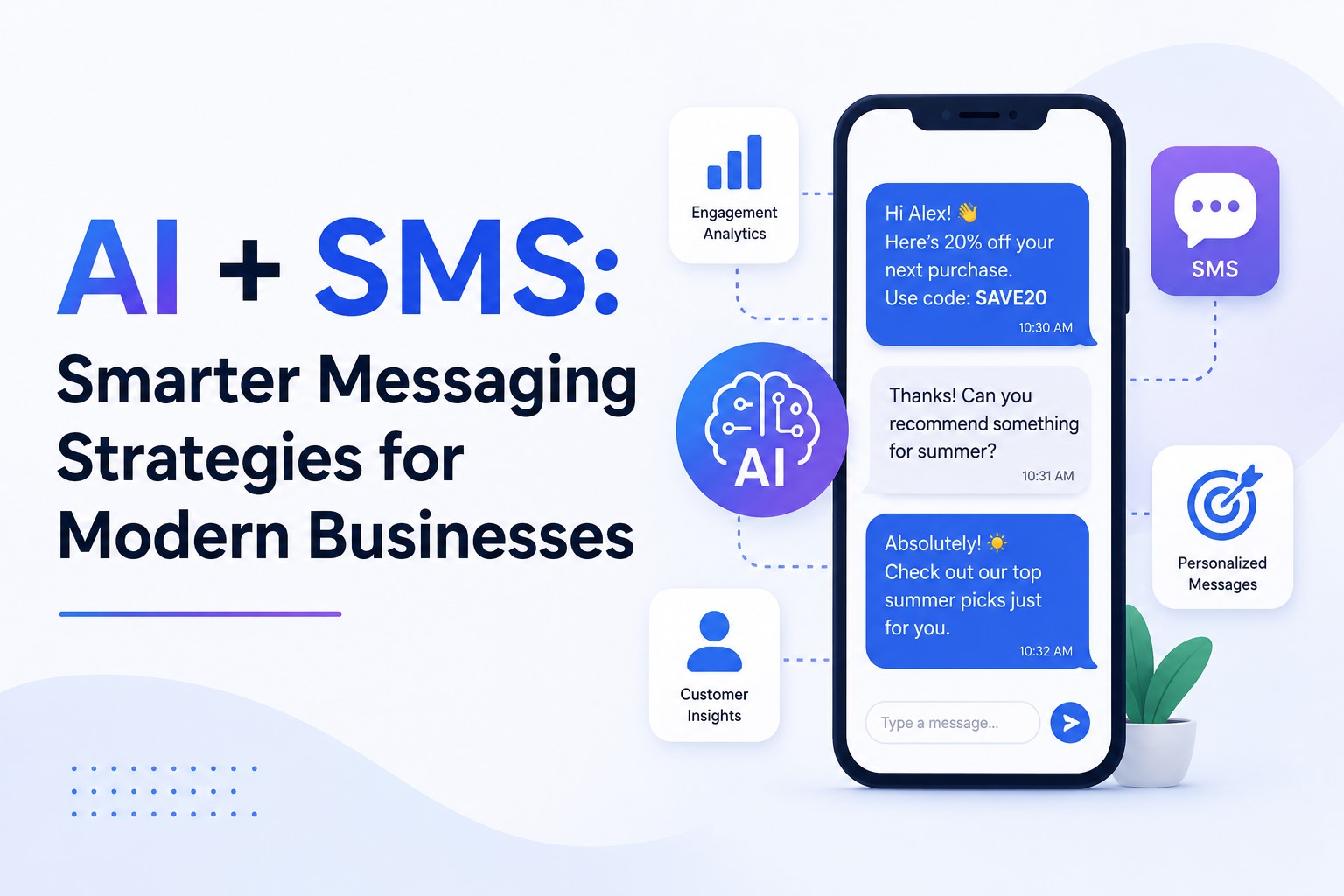
But to implement the SMS app for Salesforce effectively, your businesses need to follow some strategies. In this blog, we explore 7 practical steps that modern businesses can apply using AI in SMS marketing, each built around how a Salesforce messaging environment functions when properly configured.
From Noise to Influence: 7 Salesforce Messaging App Strategies That Work
- Segment Beyond Basic Demographics
Most SMS lists are segmented by age or location, but this is a starting point, not a strategy. With AI customer engagement tools inside Salesforce, segmentation becomes behavioral. Important details like purchase history, support interactions, email response patterns, and browsing activity all contribute to how a contact is grouped. Therefore, messages reach people based on what they have actually done, not just who they are in data collected.
- Trigger Messages from Real Customer Actions
Although campaigns scheduled are important, an action-based trigger works better. If an SMS campaign is set up to respond when a customer abandons a cart, completes a form or reaches a loyalty level, an SMS campaign can reach them before they exit their session. This level of immediacy can hardly be achieved manually and can be harder to scale unless automated. The Salesforce SMS app allows these triggers to be defined precisely, so the message logic matches the moment.
- Personalize Content at the Individual Level
Personalization lets businesses provide customized experiences for their customers and build customer loyalty. Moreover, this level of personalization is a reflection of what matters to her. It can be a product category she has been frequenting, a service she renewed last year or one of the interests she expressed during the onboarding process.
With AI in SMS marketing, you can analyze this data and automatically insert the content into text messages. As a result, messaging becomes relevant rather than routine, bringing more positive results.
- Optimize Send Times Using Behavioral Data
Different customers have different timelines or preferences; you cannot send messages at 9 AM to all. Because it may work well for one segment and poorly for another. But when you use AI customer engagement tools, you get to analyze when each contact has historically engaged, opened, clicked, or responded and schedule messages accordingly.
Over time, this produces measurable improvements in open rates without requiring manual analysis. In addition, the Salesforce messaging app handles this optimization as part of campaign setup rather than as a separate task.
- Connect SMS to the Broader Customer Journey
SMS rarely functions well in isolation. This is why, when it’s connected to email sequences, CRM records, and service case histories, it becomes part of a coordinated communication strategy. A customer who received a support resolution via email may receive a follow-up satisfaction message over SMS.
A prospect who is engaged with a product page may enter an automated SMS campaign designed for that specific interest. Salesforce makes these connections possible because the data lives in one place.
- Test Variations Systematically
What message worked for which segment and what didn’t work, cannot be decided based on intuitions. You need structured testing for this and with a Salesforce AI messaging app, businesses can run message variation tests: testing on different subject lines, calls to action, or offer structures, and let performance data determine what continues. This removes guesswork from campaign decisions and steadily improves results over successive campaigns because you work on reliable data, and not assumptions.
- Continuous Campaign Control
Campaigns don’t conclude at launch; they require ongoing tracking to check how it’s performing and where changes may be required based on feedback. If you use the Salesforce AI messaging app, real-time performance data inside Salesforce allows your marketing and operations teams to identify which automated SMS campaigns are underperforming and adjust before a significant budget is spent. You also get to see delivery rates, response rates, opt-outs, and conversions in a single dashboard, so decisions are made on current data rather than post-campaign summaries.
How to Find the Best SMS App for Salesforce?
Tip 1: Check integration depth: Make sure the app connects smoothly with the Salesforce ecosystem, removing manual updates related errors, and unifies customer records.
Tip 2: Review personalization features: Confirm whether the dynamic fields, segmentation, and lifecycle triggers correspond with the journey of the customer across channels or not.
Tip 3: Compliance is non‑negotiable: It must meet GDPR, TCPA and local regulations, and provide auditing and encryption. This will allow you to safeguard customer information and offer enterprise-level guarantee and reliability.
Tip 4: Test scalability: Ensure the app is able to manage large volume campaigns without any downtime or failure. Important considerations to evaluate delivery rates, throughput capacity, and uptime.
Conclusion
SMS is not a difficult channel to use, but it matters how it’s being used and if an effective strategy is made or not. Businesses that have a solid plan are the ones sending better, personalized and AI-driven messages, and with the Salesforce AI messaging app, they have the infrastructure to do this at scale. This is why it becomes important that your business has AI in SMS marketing as it removes the manual limitations that prevent personalization and precise timing, also makes your SMS marketing more than a broadcast practice. Hopefully, the 7 strategies discussed in the blog will help you shift your approach and bring meaningful engagement and conversion.